Amazon

NOTICE

Republishing of the articles is welcome with a link to the original post on this blog or to

Italy Travel Ideas

Wednesday, 20 August 2014

Libya Before and After the "Treatment"

These pictures speak for themselves.

The first is of Libya under Gaddafi, the second is of Libya under "democracy".
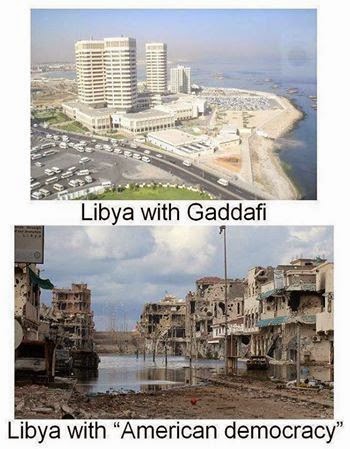
Libya under Gaddafi, Libya under democracy


H/t Alessandra Nucci

Sunday, 17 August 2014

Islamic Hatred and Persecution of Christians Is Imported into European Refugee Centres


Christians persecuted by Muslims in Islamic countries who think they are escaping their fate by fleeing discover that the same treatment awaits them in Europe, which after all has simply imported Islam's barbarism by opening its doors to large numbers of Muslims.

The German daily newspaper Die Welt reports on the terrible exclusion and violence suffered by Christian refugees at the hands of Muslims in Germany's asylum centres.

Germany is the second country in the world, after the US, for number of asylum applications received, with 13% of them last year, and the first in Europe, with 23.2% last year.

The report starts with some figures:
In Iraq, there are currently 30,000 Christians fleeing. But these are only those who are currently in the main news. Worldwide suffering estimate by humanitarian organisation Open Doors is around 100 million Christians under persecution. The organisation World Watch List 2014 has particularly strict Islamic countries - such as Somalia, Syria, Iraq, Yemen, Iran, Saudi Arabia and Pakistan - among the ten states with the worst persecution of Christians.
An example of the discrimination suffered in German reception centres for refugees is what happened to Leyla S, an Iranian whose Christian faith compelled her to flee to Germany about three years ago with her husband and daughter.

The woman related to Die Welt her experience in the reception centre in Hessen, where about 20 of the approximately 100 other refugees cursed the family from the beginning again and again as “infidels” and “dirty dogs” and banned Leyla from the two kitchens.

"For two years", she says, "we always had to cook in our room. Once I tried to go in the communal kitchen, but the Muslim refugees from Afghanistan housed in the centre immediately chased us away, claiming that our presence rendered the food impure.

"Why then are these people coming to Germany, home to millions of Christians, who for them are unclean, although not their money?"

Die Welt also exposes the wall of silence of the authorities. In the refugee camps of Baden-Württemberg, North Rhine-Westphalia and Hesse, those responsible say that there are no cases of discrimination, while in reality they happen under the roofs of the refugee camps. The incidents take place in silence, hidden from the police.

Max Klingberg of the International Society for Human Rights (ISHR), an organisation that for 14 years has been working with refugees, explains that attacks against Christians are far from isolatd cases and that all Christians and Christian converts arriving in Germany are victims of harassment, threats, pressure.

And psychological violence sometimes leads to physical violence. In the case of an Iranian Christian convert, a woman, Muslim men urinated on her clothes and other personal effects to humiliate her.

The situation is so bad that in Bavaria, in order to stop the violence, separate accommodation for different religious groups of refugees has been requested.

Since the moment of his arrival at the reception centre Ramin, an Afghan refugee who converted to Christianity, has been threatened by three Muslim countrymen with whom he shared the room. He recounts: "They said that I belonged to the Dar al-Harb [house of war, as Islam calls all the part of the world which is non-Muslim] and not the Dar al-Islam [house of Islam]." For the three Afghan Muslims, Ramin deserved death as an infidel and apostate.

The man tells of various attacks, including one that led very close to his death: "We were in the room when my three roommates beat me in the kidneys with the remote. When I managed to wriggle out, one of them went into the kitchen and took a knife. I then attempted to flee in another room, but another had blocked the door with his foot. At that moment I was shaking, I turned to Jesus asking Him to save me. Then one of the men pointed the knife to my chest, saying that it would be impossible for me to stay alive for much longer. Fortunately, the other two reminded the man that he had to suspend for the time being his revenge, since he had yet to complete his application for political asylum."

In line with the constant denial of Muslim supremacism and Islamic persecution of Christians, authorities more often than not don't deal with these cases of hatred. An Iranian 19-year-old Christian tried to escape his Mohammedan tormentors by asking for a transfer to another city. The local council refused the application on the grounds that the dispute had nothing to do with religion but was purely personal.

Peter Ulrich, director of a free school for asylum seekers managed by the Evangelical Free Church, says that Christians are much closer to European culture and far better capable of integration than Muslims. No surprise here.

"In my work as a teacher of German language" he adds, "I have observed that many refugees from Syria, Iraq and Iran seek asylum precisely because of religious persecution. They are disappointed and irritated by how often their problem is not taken seriously by the authorities of our country, from which they instead expect understanding and support."

The solution is pretty simple not just for Germany but for all of Europe: give asylum to Christians, deny it to Muslims.

Friday, 15 August 2014

What's the Alternative to the Left's Program?

A homosexual couple gets married in Brighton, UK


Published on American Thinker

By Enza Ferreri


I was reading the blog of Daniel Greenfield, undoubtedly a great writer and an acute analyst of what is wrong in today's world.

But, the more I was reading, the more I felt a sense of dissatisfaction, as you may have when drinking doesn't quench your thirst but paradoxically increases it.

Then I discovered what it was. There was something missing: a conclusion.

We - the counterjihadists, the "Islamophobes", the conservatives, the "Right wing" - have many excellent thinkers and commentators (of whom Greenfield is an example) who are good in the pars destruens, the critical, negative part, of our arguments; but not enough who develop a pars construens, the constructive part that builds the positive alternative to what we are criticising.

This dearth of a firm propositive aspect in our positions is common to all Western countries.

The reason, I dare say, is simple. There is among us a widespread fear or unease in proposing a kind of society espousing ideas and values (some of which from the past) that have been ruthlessly, thoroughly mauled and massacred by the Left.

We are, probably without realising, the first victims of Leftist indoctrination. We may reject those ideas rationally, but deep down, emotionally, we have doubts. The Left’s are the views we grew up with, they permeated our culture, were ideologically dominant when we were teenagers and young adults. Our favourite bands endorsed them and were selling them with their records and their lives: sex, drugs and rock'n'roll.

At university, both professors and students were full of them; who thought differently was a pariah.

The most fashionable authors were Marxists of various kinds, from Freudian Marxists to the Frankfurt School.

It would be totally unrealistic to think that an individual can go through all that brainwashing, peer pressure and gentle persuasion by his pop idols without taking with him a persistent scar, a lifelong influence on his mind.

So, when we slowly - it took a very long, long time - realised that those ideas (that for want of a better word I'll shorthandedly call "Leftist") were simply wrong, that they didn't correspond to reality - didn't "save the phenomena" as an obscure scientist named Sir Isaac Newton, among others, put it - and their acceptance and practical application were destroying both individuals and societies, we found our voice in denouncing them and their manfestations.

What we didn't find in equal measure was the audacity, the resolve to recover and re-propose the beliefs and principles that preceded the Leftist ones, and which the Left with its atheism and political correctness had demolished in our eyes.

No matter how much the world around us - in our surroundings, streets and urban ghettos as well as in faraway lands - was collapsing, there were words like "defending family values" or "sexual morality" or "not all religions are the same/religion can be a force for good" we just couldn't bring ourselves to utter.

We need to reclaim the convictions supplanted by Leftist barbarism. We mustn't be afraid to say that the alternative to Islam is Christianity, the answer to sexual relativism, pansexualism, radical feminism and homosexualism is in the Judaeo-Christian civilisation, and that the West can survive only if it reasserts its identity as Christendom.

This is the constructive, propositive part that at the moment is largely missing from the anti-jihad and conservative public discourse.

It's not enough to correctly identify what's wrong. If we don't have a positive recipe on how to fix it, we'll lose to those who have a proposal, however abysmal.

Thursday, 14 August 2014

Is the Pope Suggesting the Use of Force in Iraq?

Iraqi Christian


The Vatican has found its voice.

Pope Francis wrote a letter to Ban Ki-Moon, UN Secretary General, asking him to "do everything you can to stop the violence against Christians in Iraq". The letter, received by Ban Ki-Moon on 13 August, is the latest of the Pope’s interventions to stop the persecution of Christians and other religious minorities in Iraq.

He writes:
It is with a heavy and anguished heart that I have been following the dramatic events of these past few days in Northern Iraq where Christians and other religious minorities have been forced to flee from their homes and witness the destruction of their places of worship and religious patrimony. Moved by their plight, I have asked His Eminence Cardinal Fernando Filoni, Prefect of the Congregation for the Evangelization of Peoples, who served as the Representative of my predecessors, Pope St John Paul II and Pope Benedict XVI, to the people in Iraq, to manifest my spiritual closeness and to express my concern, and that of the entire Catholic Church, for the intolerable suffering of those who only wish to live in peace, harmony and freedom in the land of their forefathers.

In the same spirit, I write to you, Mr Secretary-General, and place before you the tears, the suffering and the heartfelt cries of despair of Christians and other religious minorities of the beloved land of Iraq. In renewing my urgent appeal to the international community to take action to end the humanitarian tragedy now underway, I encourage all the competent organs of the United Nations, in particular those responsible for security, peace, humanitarian law and assistance to refugees, to continue their efforts in accordance with the Preamble and relevant Articles of the United Nations Charter.

The violent attacks that are sweeping across Northern Iraq cannot but awaken the consciences of all men and women of goodwill to concrete acts of solidarity by protecting those affected or threatened by violence and assuring the necessary and urgent assistance for the many displaced people as well as their safe return to their cities and their homes. The tragic experiences of the Twentieth Century, and the most basic understanding of human dignity, compels the international community, particularly through the norms and mechanisms of international law, to do all that it can to stop and to prevent further systematic violence against ethnic and religious minorities.

Confident that my appeal, which I unite with those of the Oriental Patriarchs and other religious leaders, will meet with a positive reply, I take this opportunity to renew to your Excellency the assurances of my highest consideration.

From the Vatican, 9 August 2014

FRANCISCUS PP.
In an interview with the Vatican Radio, Monsignor Silvano Maria Tomasi, Permanent Observer of the Holy See to the United Nations in Geneva, appears to interpret the Holy Father's letter as an invitation to the UN to act even by recourse to force. He said:
What impressed me is the phrase saying that the situation is so tragic that it "compels" the international community to act. In fact, if we look at the Charter of the United Nations, we see, very clearly, that Article 42 says that the international community has the responsibility to protect even by force - which cannot be done by the local state, local authorities, who for various reasons are prevented to act or do not have the opportunity to do so, after you have tried all the ways of the law, dialogue, negotiation - to avoid evils like those seen in Northern Iraq in these days.

But it is clear that "by force" is the ultimate solution, the final step...

[T]his is not a defence of Christians and other religious minorities, merely in an action of direct support to Christians: here we are dealing with human beings whose fundamental rights are trampled upon and for whom the local authorities cannot intervene. Therefore, the duty of the international community is to protect them. The problem is not, in simple words, a Church problem, it is a problem of humanity, of the human family.

Second, we must find ways to limit, to try to block the fact that weapons, financial aid and politicians continue to get into the hands of the representatives of this elusive state of the Caliphate, which so far has just been an excuse to create violence and kill those who are in disagreement with the leaders of this new entity. [Emphasis added]
Monsignor Tomasi recalled the situation years ago in Rwanda, similar to today's Iraq, saying that genocide was not prevented due to not having acted decisively.

Also speaking to Radio Vaticana was Cardinal Angelo Bagnasco, President of the Italian Episcopal Conference. He said that the Vatican will help Iraqi refugees to find homes. He announced the Day of Prayer for the Persecuted Christians, tomorrow 15 August, the major feast Day of the Assumption.

Today, on the eve of the Assumption Day, the Archbishop of Ferrara Luigi Negri displayed on the facade of the Archbishop's Palace the ن symbol of Christians persecuted by jihadists in Iraq, with a message explaining the reasons.